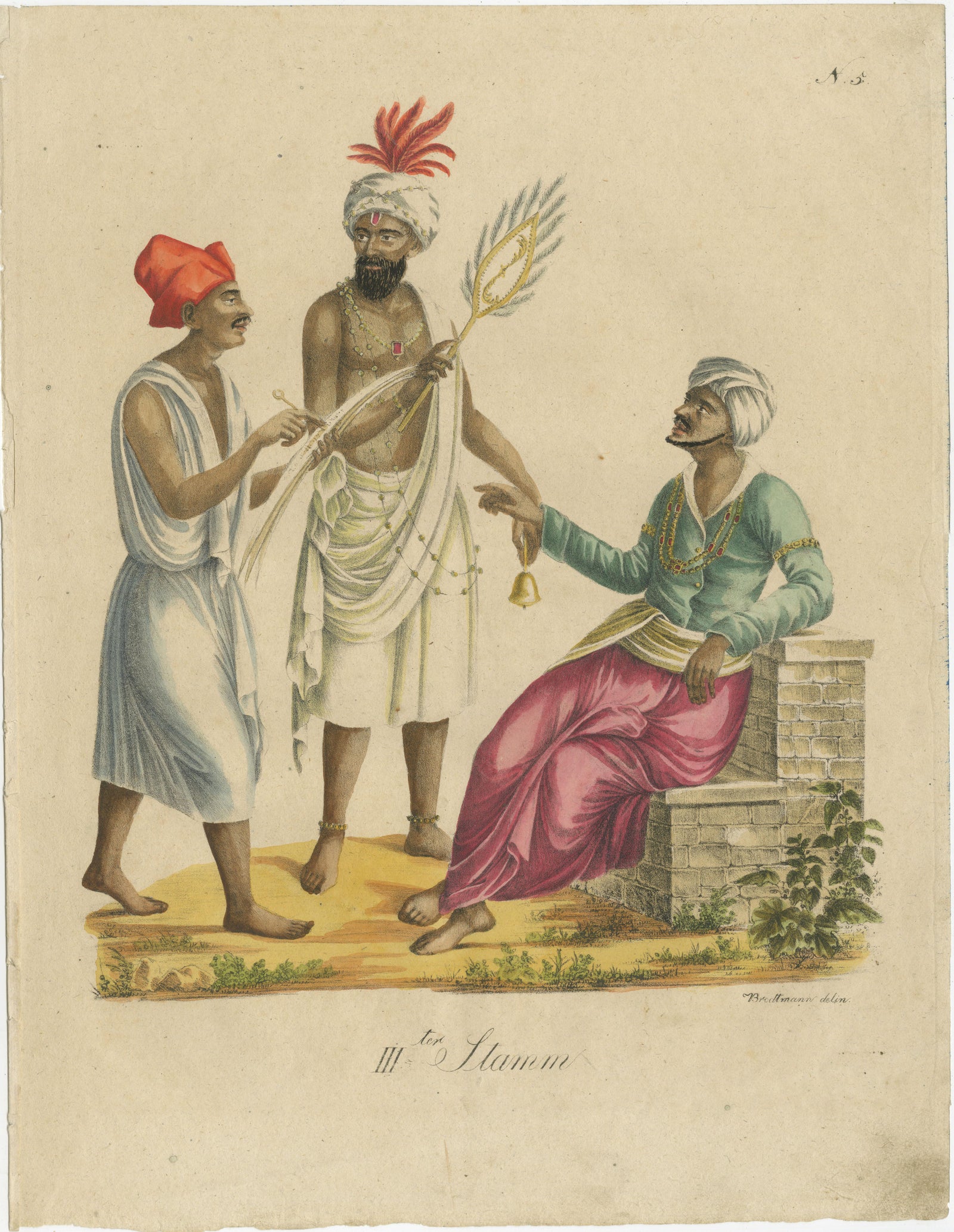
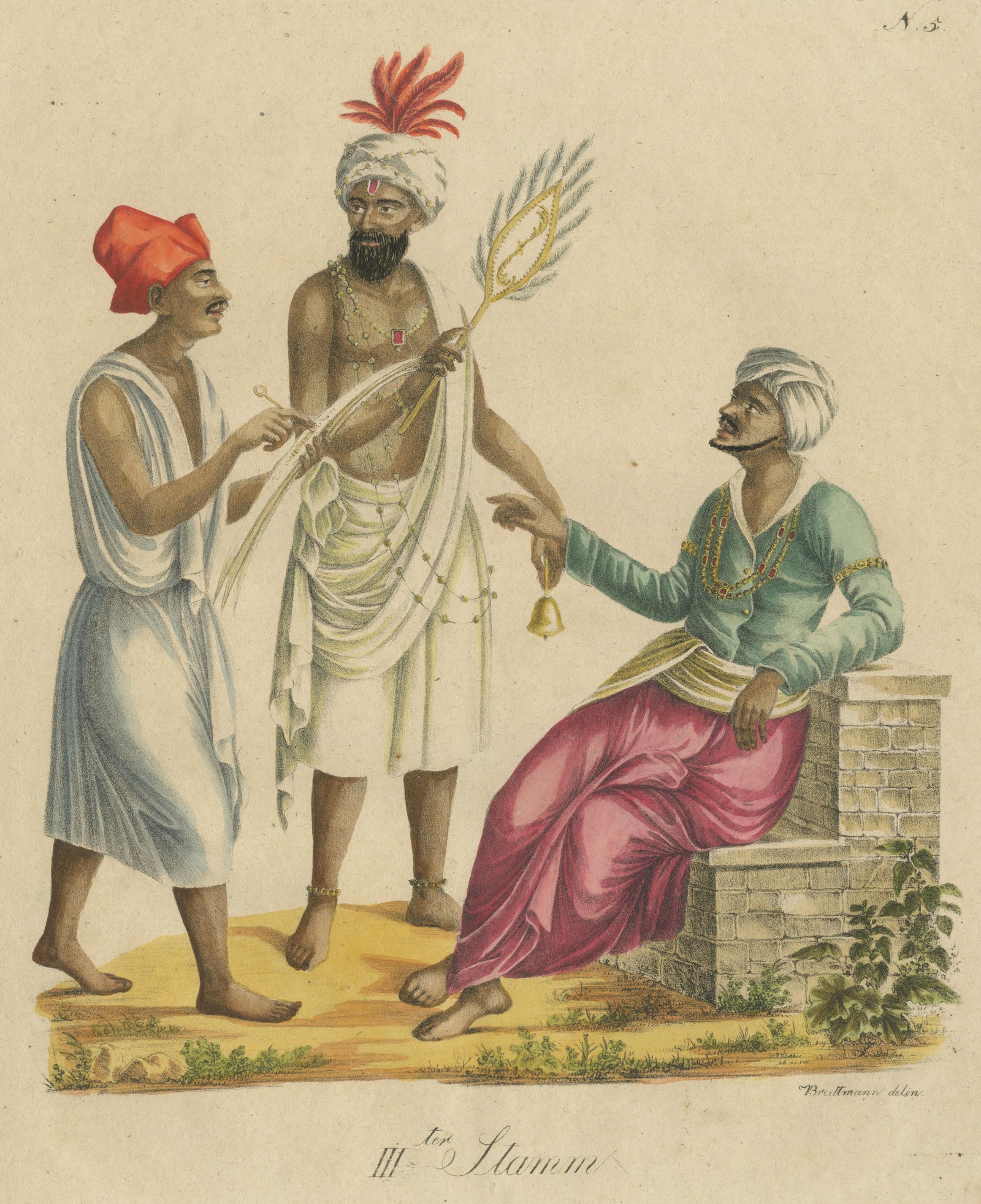
IIIter Stamm, Indian Men in Traditional Dress c.1816
$550
€490 · £415
Original print, not a reproduction.
Ships worldwide from the Netherlands, flat, insured and tracked. 14-day returns. To buy, use Ask a question and we will reserve the print for you.
- Date
- 1816
- Sheet size
- 17 × 13.1 in (43.2 × 33.3 cm)
- Condition
- Good. Condition summary: Very good condition with strong, clean paper, fresh and vibrant hand colouring, minimal toning, and no significant tears or repairs. There is only minor foxing visible near the margins. Paper remains firm and stable.
- Wardrobe
- Far & away
- Era
- 1790 to 1840, Empire and Romantic
- Stock no.
- f_36142932
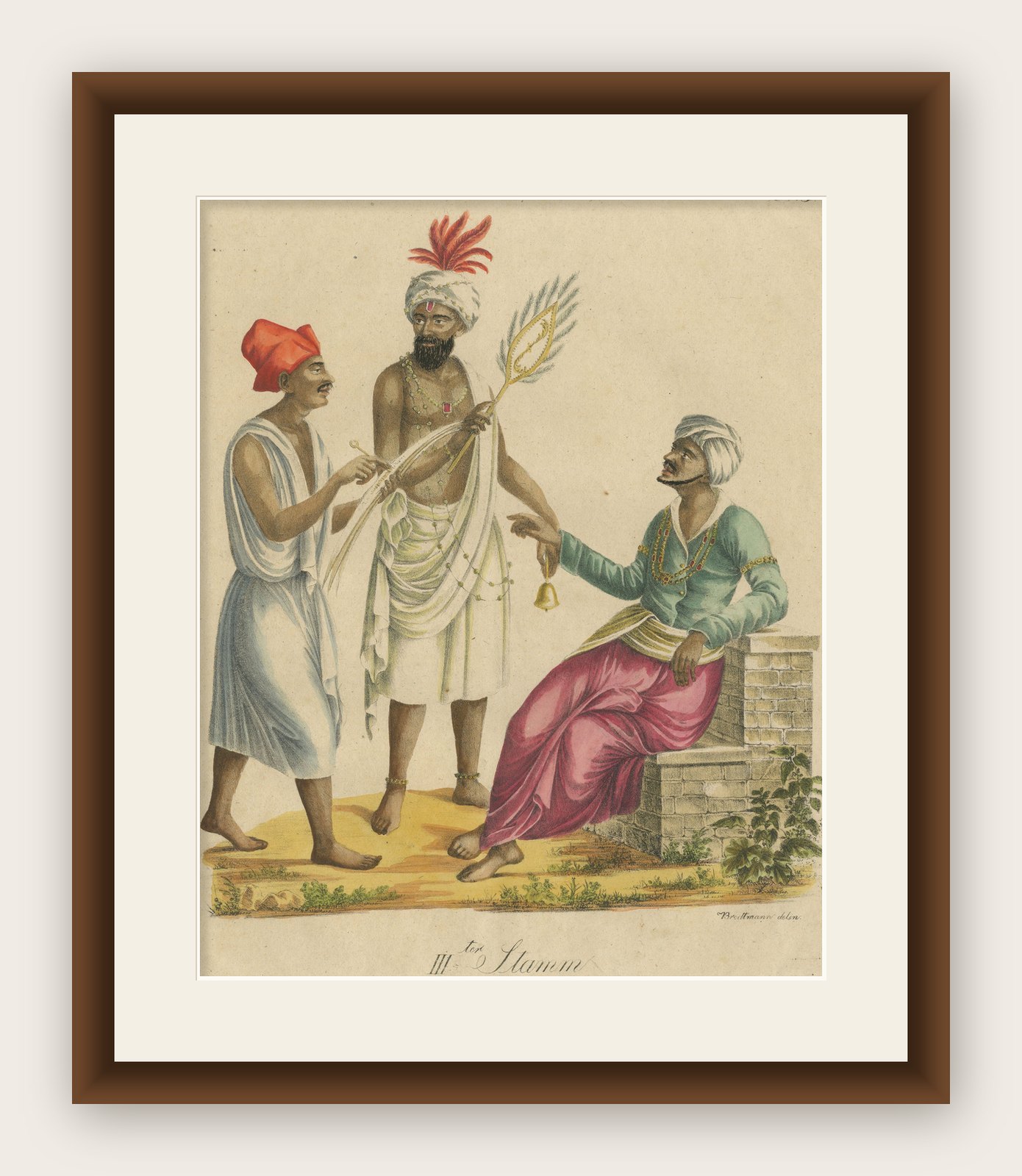
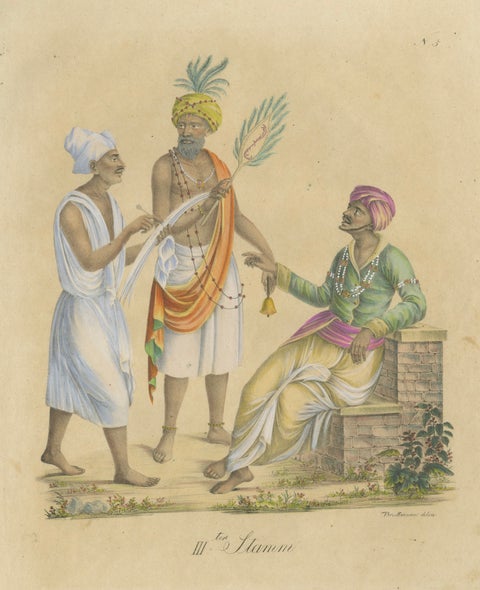
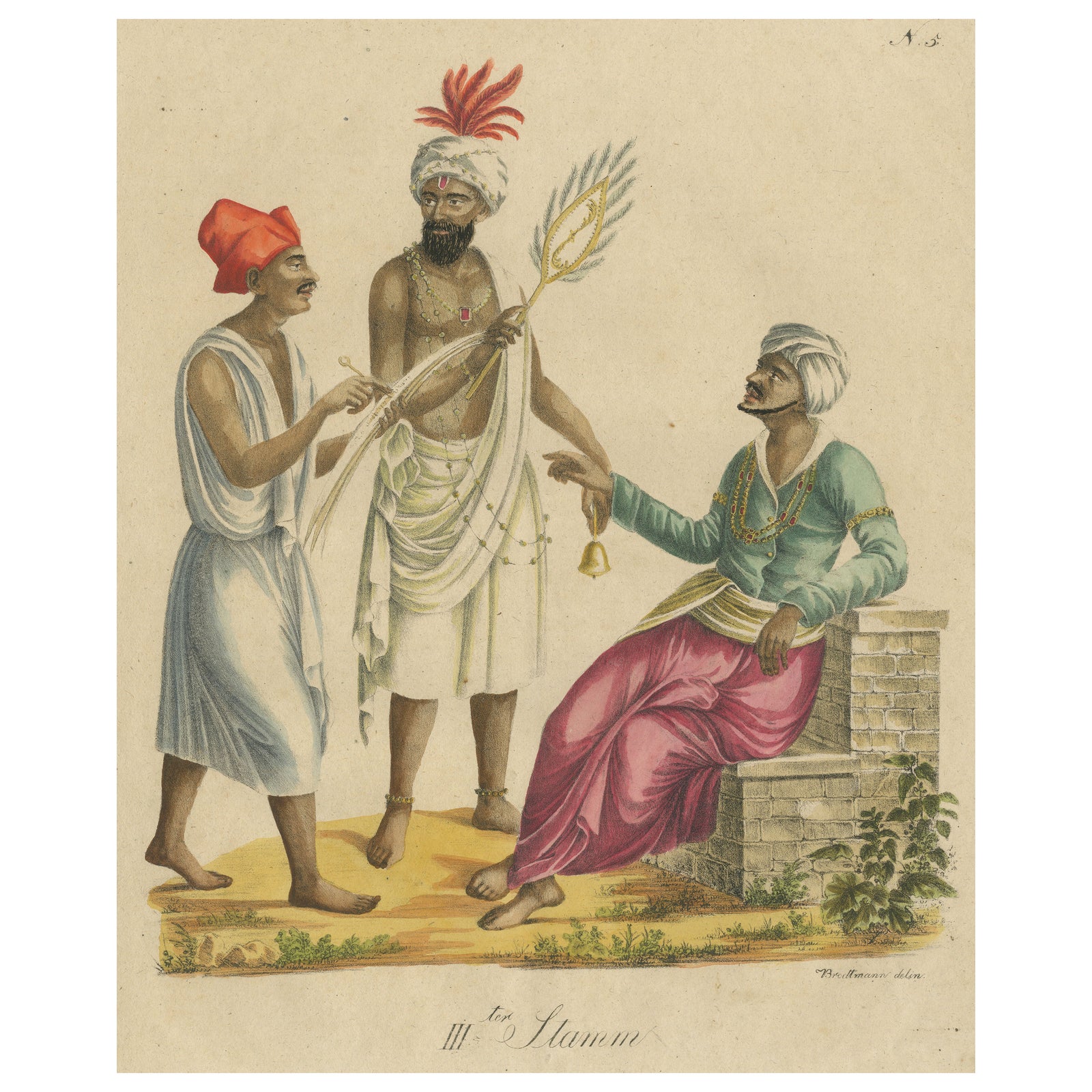
IIIter Stamm, Indian Men in Traditional Dress c.1816
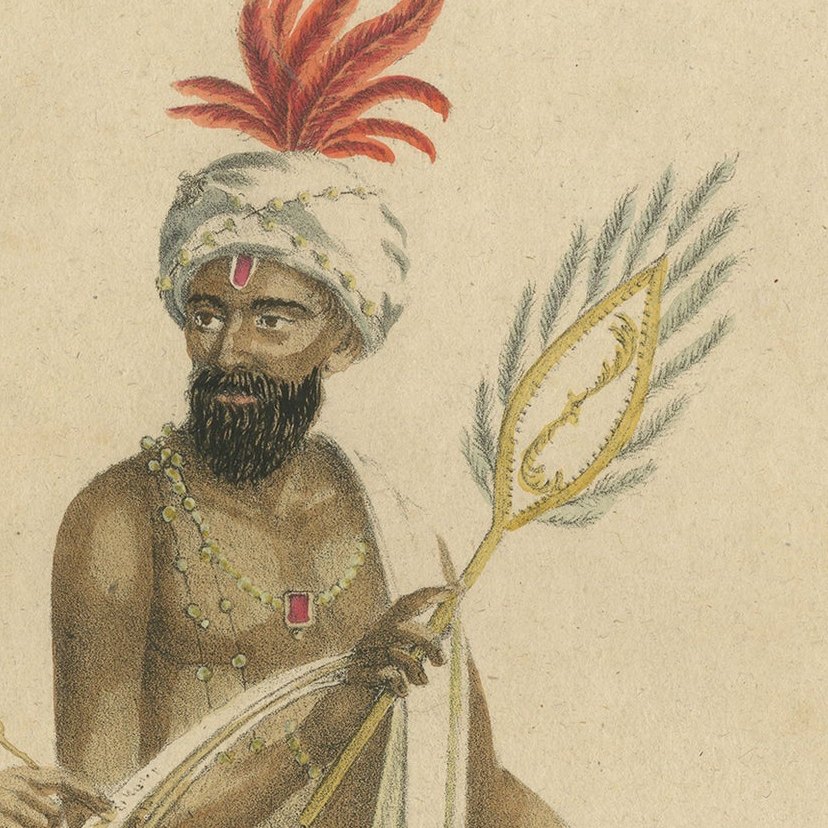
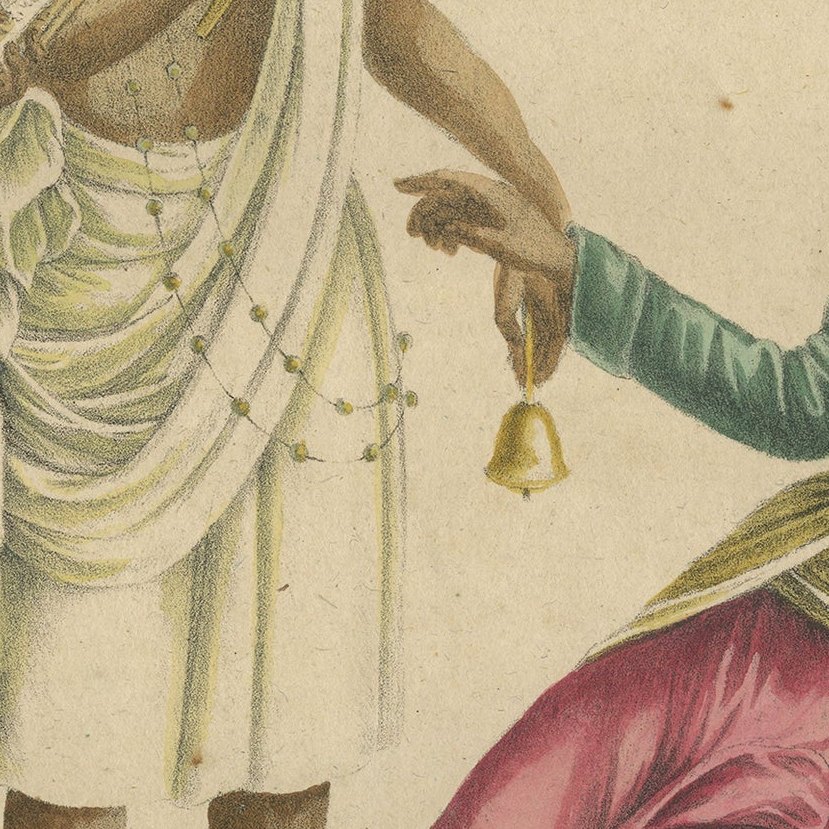
This antique print depicts three men from India, each wearing traditional attire that reflects the regional and occupational diversity of early 19th-century Indian society. The man standing on the left wears a red turban with a simple white dhoti, suggesting a merchant or townsperson. The central figure holds a ceremonial staff adorned with palm leaves and carries a bell, indicating his role as a priest or temple official; his elaborate feathered turban, draped cloth, and jewellery underline his status. The third man, seated on a low stone platform, wears a white turban, a teal-blue tunic, and bright pink trousers, representing Mughal or princely influence in his elegant pose and garments.
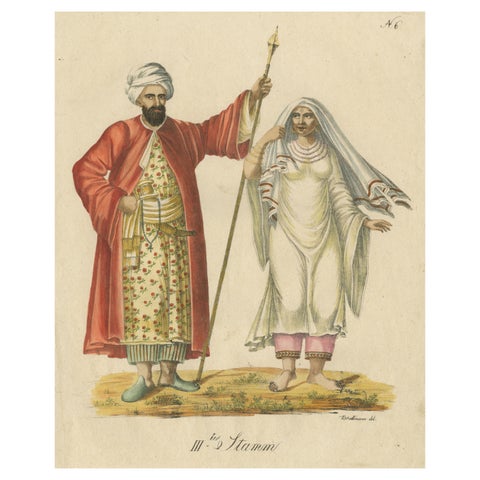
This lithograph is from ‘Naturhistorische Bilder-Galerie’ by Karl Joseph Brodtmann, published circa 1816. Brodtmann’s works are renowned for their finely detailed lithographic technique combined with precise hand-colouring. At this time, European curiosity about the Indian subcontinent was at a peak, following British colonial expansion and earlier Portuguese, Dutch, and French encounters. Prints such as this were popular educational and decorative items, presenting European audiences with vivid images of the clothing, customs, and perceived hierarchies of Asian and African peoples.
Brodtmann’s choice of lithography allowed for greater tonal variation than earlier engraving methods and facilitated wider distribution. His ethnographic prints, while reflecting the orientalist perspective of the time, remain valuable historical documents capturing the costume and posture conventions used in early 19th-century ethnographic art.
Condition summary: Very good condition with strong, clean paper, fresh and vibrant hand colouring, minimal toning, and no significant tears or repairs. There is only minor foxing visible near the margins. Paper remains firm and stable.
Framing tips: This print will look elegant with a soft cream or light ochre mount to accentuate the warmth of the clothing colours. A teak or dark rosewood frame enhances the print’s ethnographic richness, while a thin gold-lined black frame gives it a refined gallery appearance. Use UV-protective glass to preserve the delicate pigments of the lithograph.