Close-ups
Antique Print of the Tangut People in China by Athanasius Kircher, c.1660
£195
$255 · €230
Original print, not a reproduction.
Ships worldwide from the Netherlands, flat, insured and tracked. 14-day returns.
- Date
- 1660
- Sheet size
- 13.8 × 8.9 in (35 × 22.7 cm)
- Condition
- Fair. To good impression on laid paper. Some toning, light foxing, and staining, particularly toward the lower margin, with minor creasing at corners. Text and related engraving on verso visible.
- Wardrobe
- Far & away
- Era
- Before 1700, Baroque
- Stock no.
- f_46301012
What the condition grades mean
- Excellent
- Bright and clean, with no faults worth mentioning.
- Very good
- Only light signs of age, such as faint toning.
- Good
- Normal signs of age for a sheet of this period: toning, some foxing, small marks or neat old repairs.
- Fair
- Clear faults such as staining, tears or repairs, priced to match.
Every fault we see is written in the condition note, and the whole sheet is shown uncropped in the photos.
Antique Print of the Tangut People in China by Athanasius Kircher, c.1660
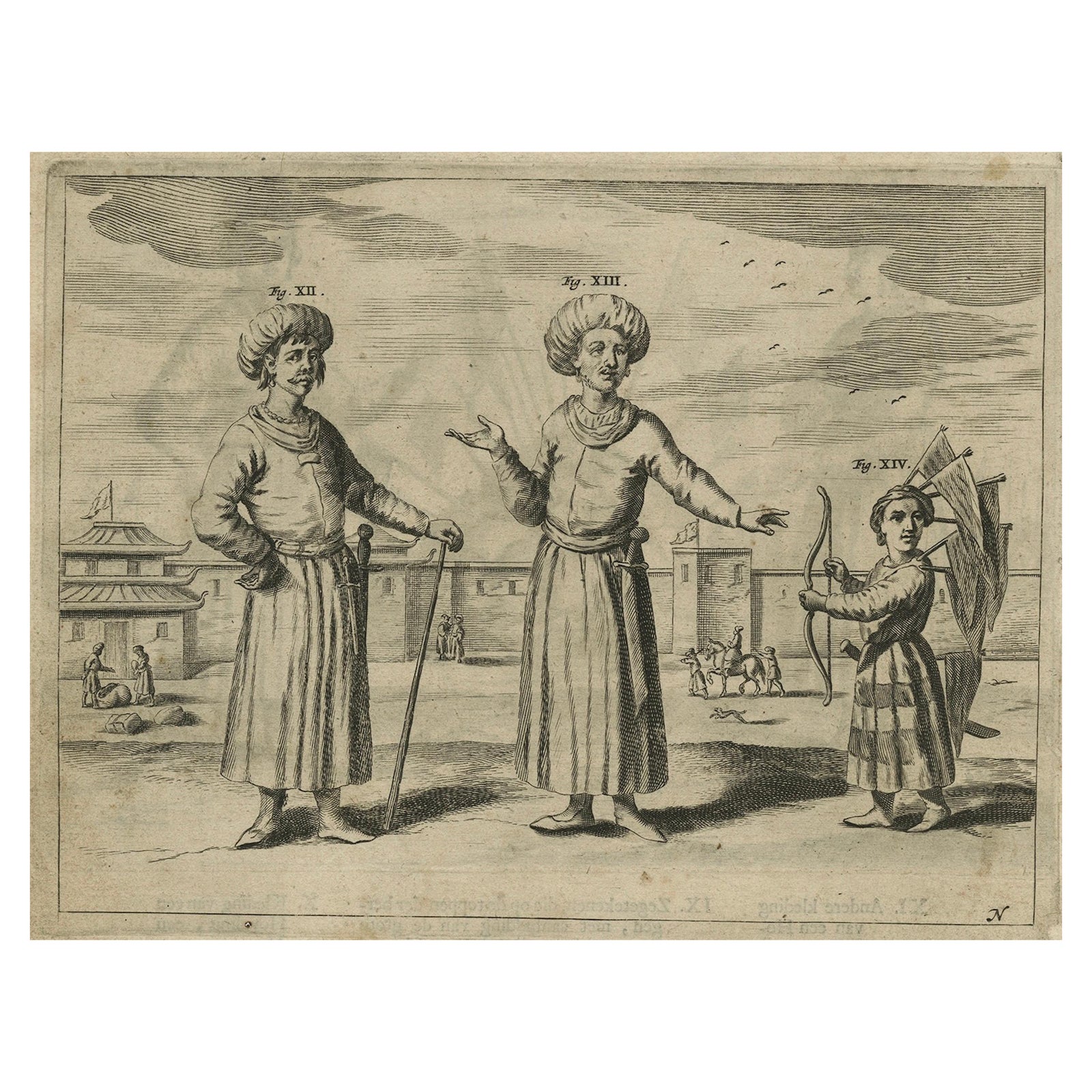
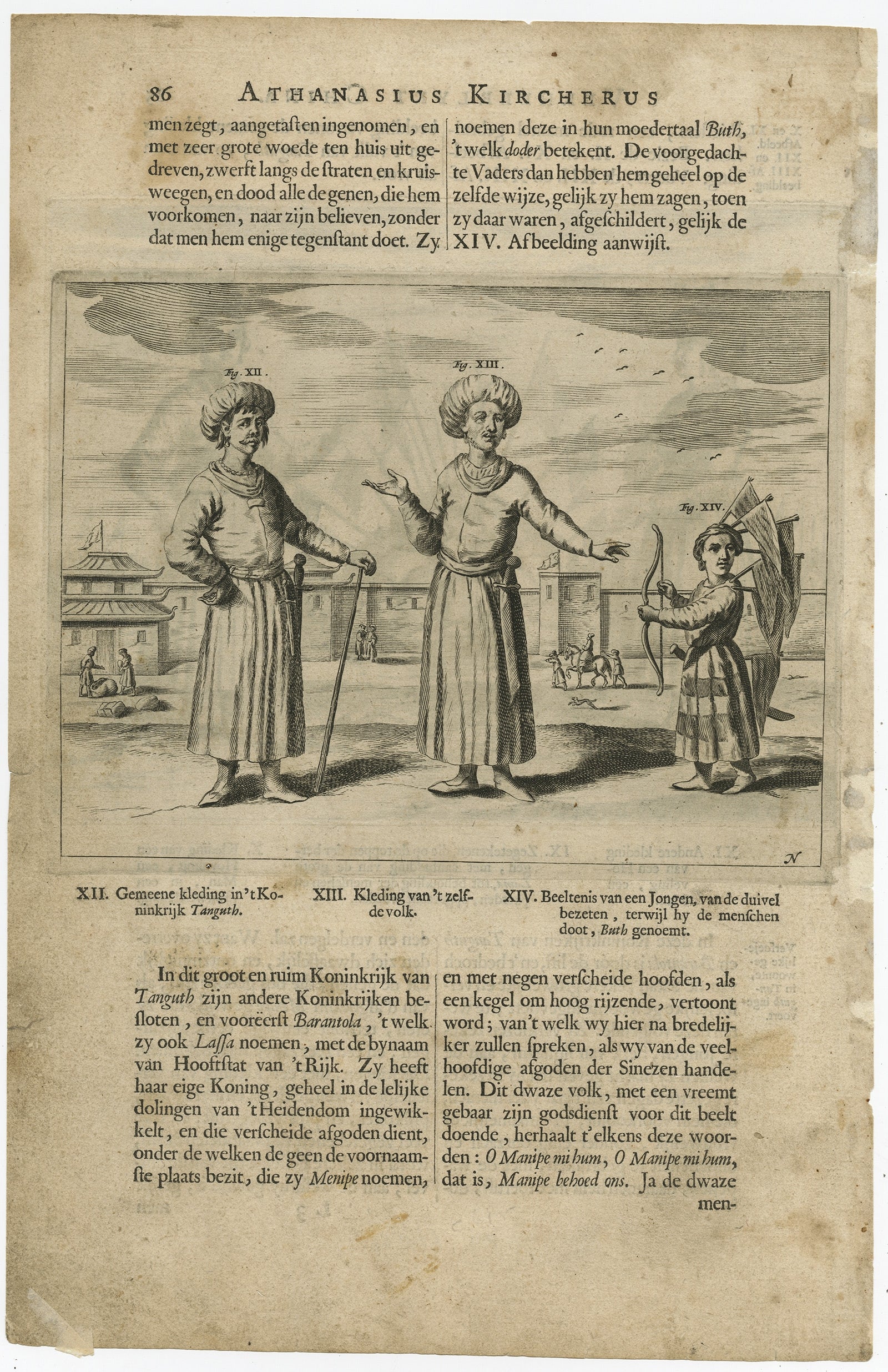
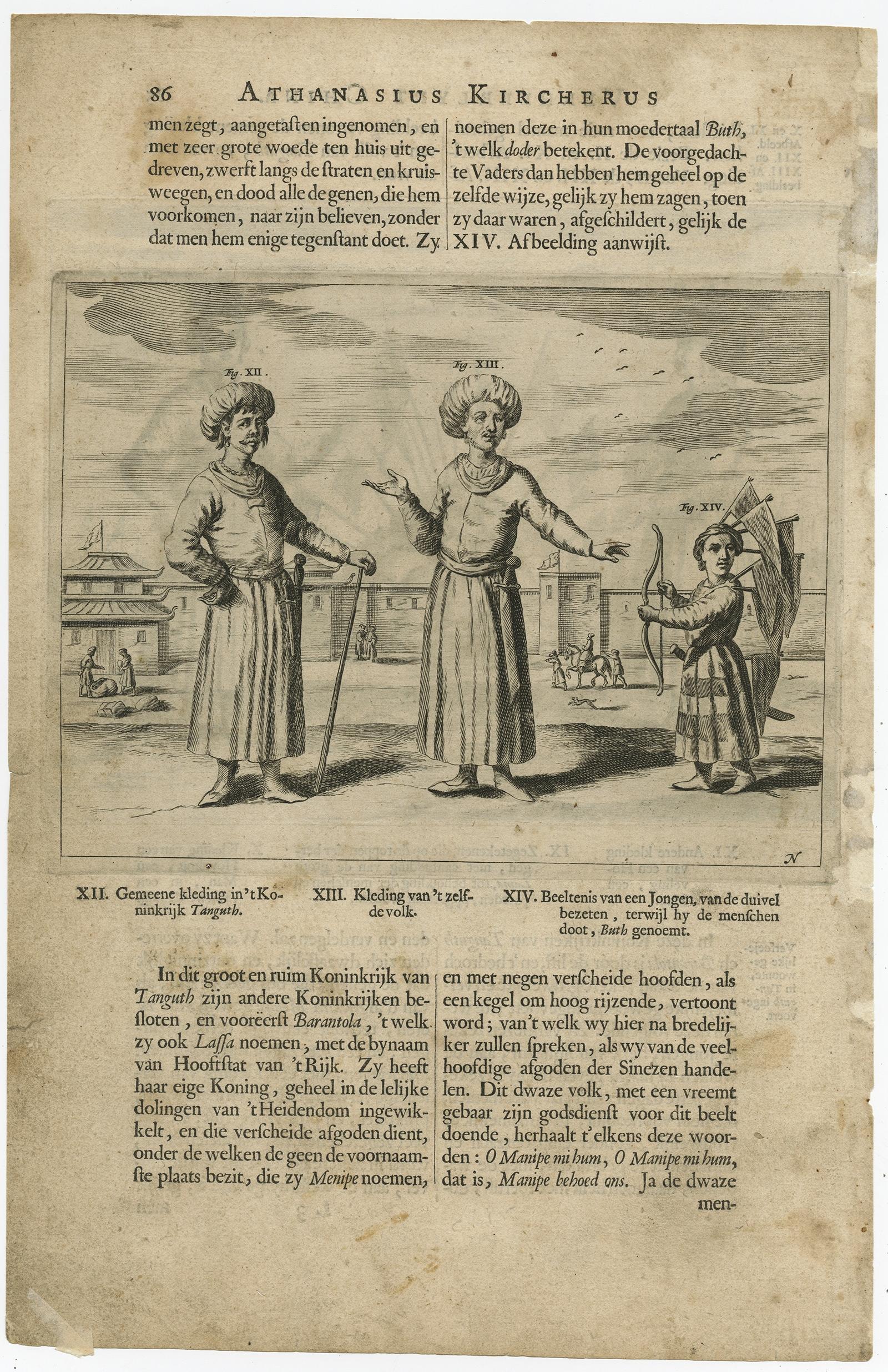
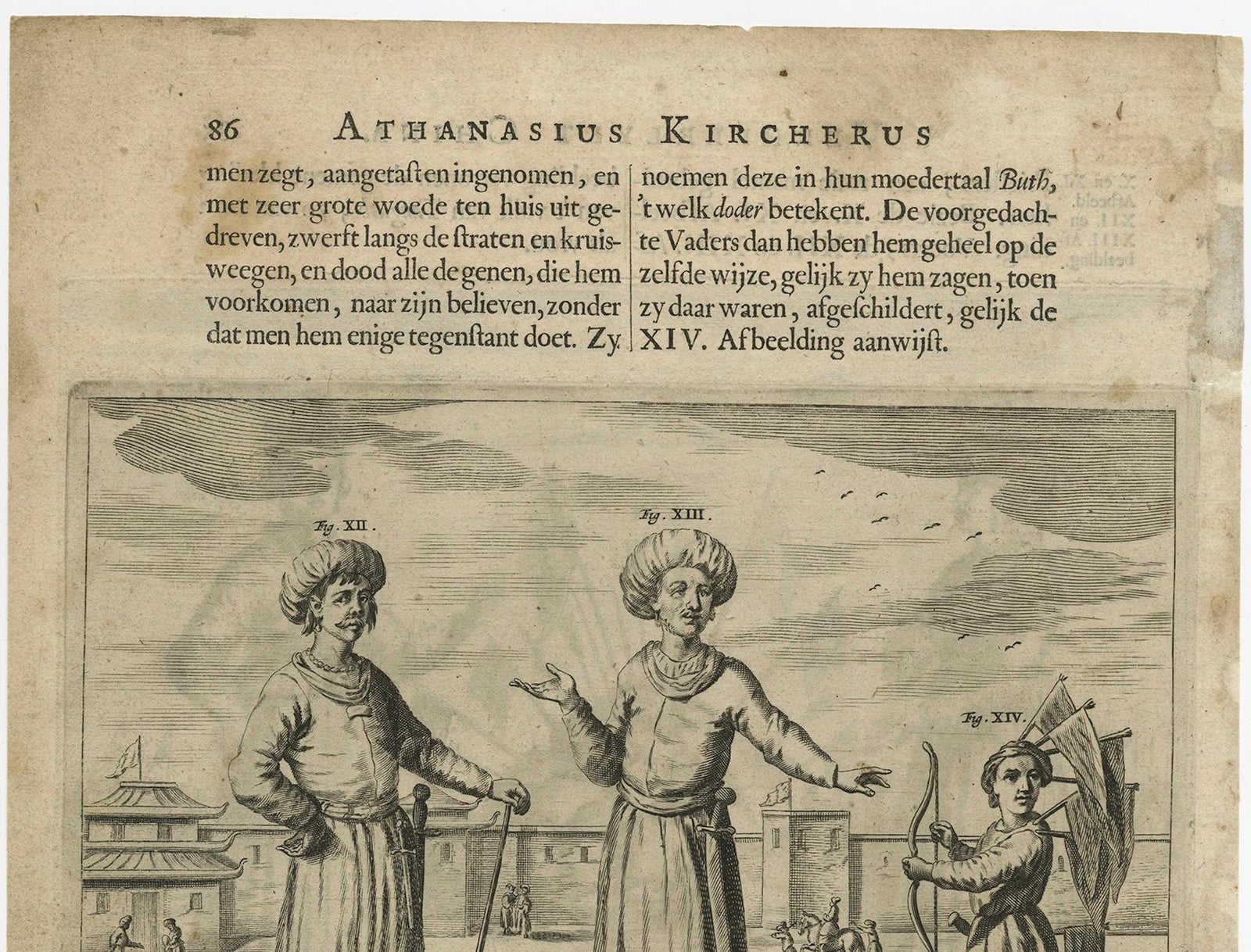
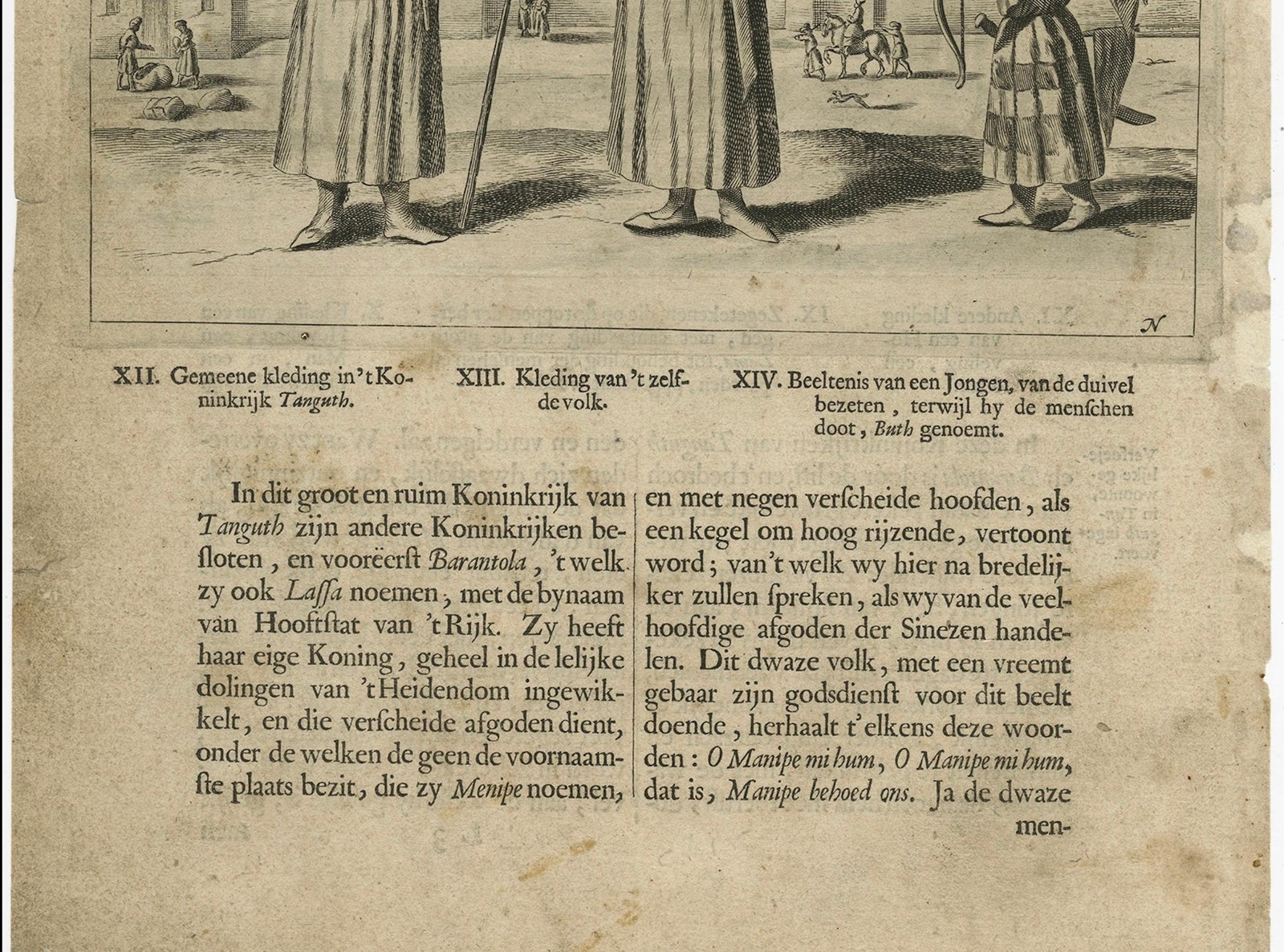
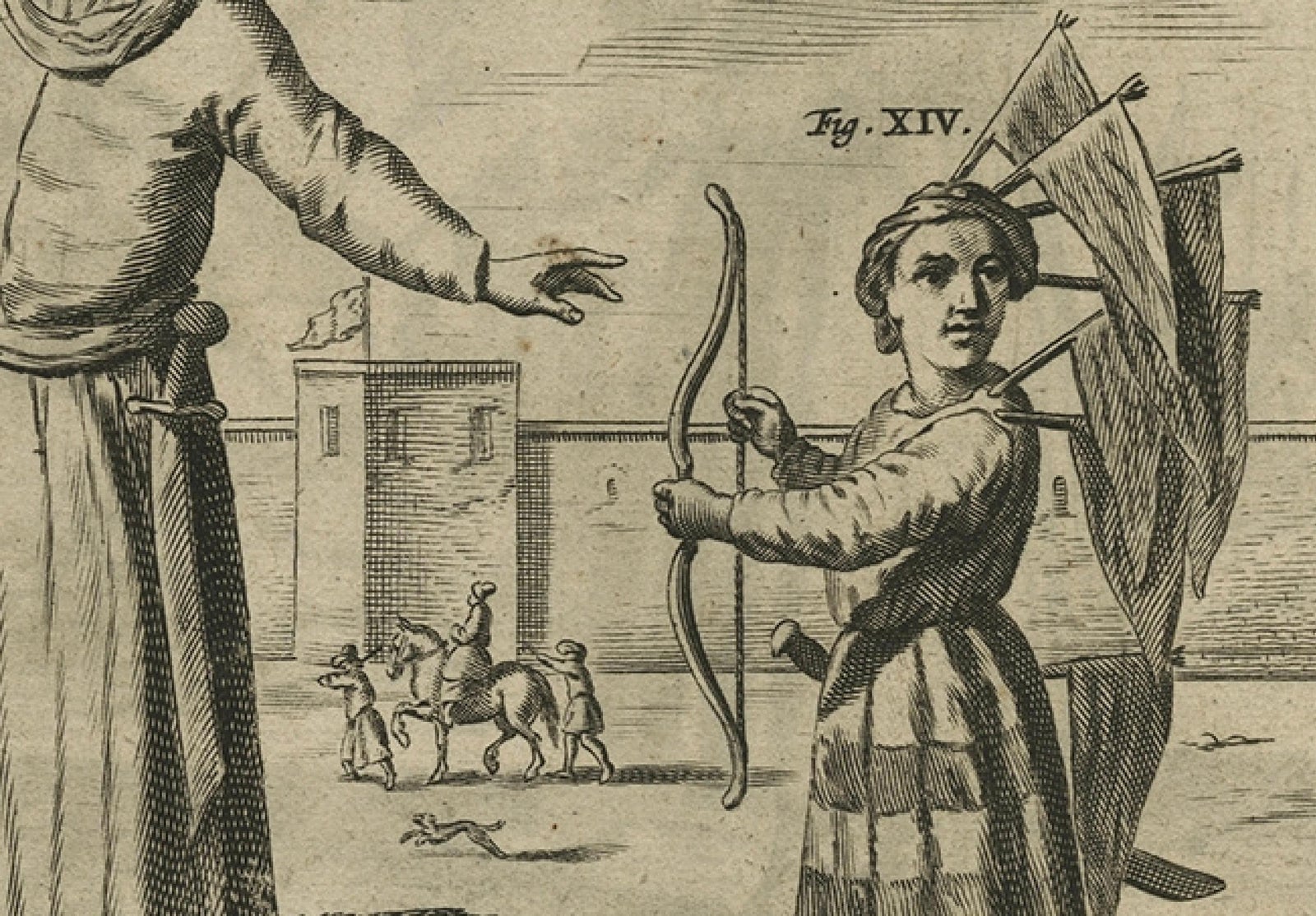
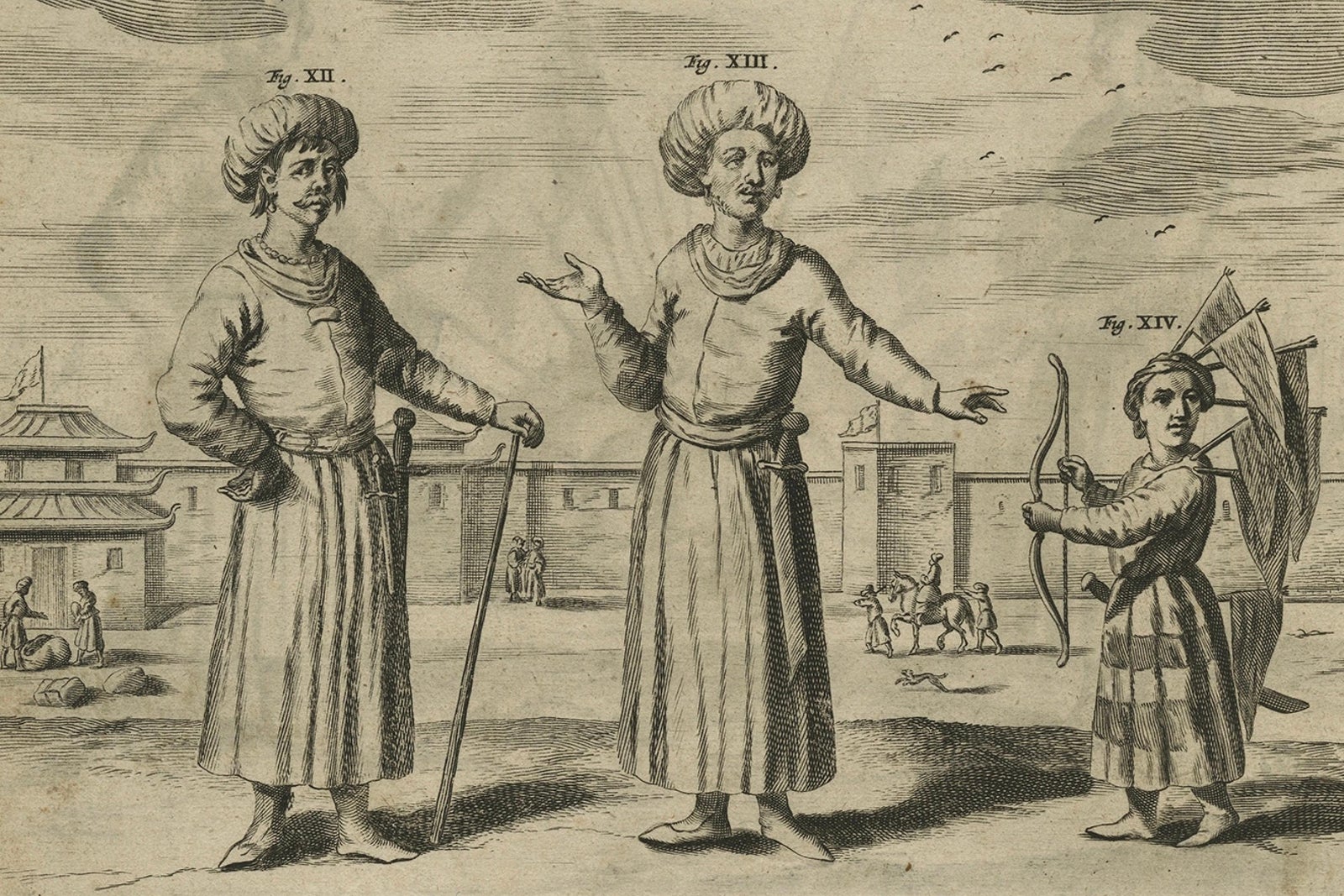
This rare 17th-century engraving shows the traditional dress of the Tangut people in western China, as described by the Jesuit scholar Athanasius Kircher. Two men in long robes and turbans stand in the foreground, while a boy, depicted as possessed by a demon (labeled “Buth”), carries a bow and shield. The background contains architectural structures and small groups of figures, situating the scene within an Asian setting.
The Dutch text identifies the figures as follows: “Gemeene kleding in ’t Koninkrijk Tanguth” (ordinary clothing in the kingdom of Tangut), “Kleding van ’t zelfde volk” (clothing of the same people), and “Beelteins van een jongen, van de duivel bezeten” (image of a boy possessed by the devil). These descriptions reflect the way Europeans of the period interpreted foreign cultures through a mixture of observation, religious imagination, and hearsay.
The print originates from one of Athanasius Kircher’s encyclopedic works, most likely China monumentis qua sacris qua profanis illustrata (1667), a monumental study of Chinese religion, customs, language, and culture. Kircher (1602–1680), a German Jesuit polymath based in Rome, produced more than forty publications across disciplines including oriental studies, geology, medicine, and linguistics. His works were widely circulated and remain an important record of early European encounters with Asia.
Kircher’s China Illustrata was one of the earliest attempts to systematically present Chinese civilization to a European readership, blending missionary reports with his own interpretations. The depictions of costumes and rituals were often imaginative reconstructions, but they played a significant role in shaping early modern European perceptions of Asia.
Condition: Good impression on laid paper. Some toning, light foxing, and staining, particularly toward the lower margin, with minor creasing at corners. Text and related engraving on verso visible.
Framing tips: A simple dark wood or ebony frame will provide a scholarly, museum-like presentation, while a gilt frame with a cream mat can highlight its historical character as a 17th-century ethnographic print.
Technique: Engraving
Maker: Athanasius Kircher, after an anonymous artist, Rome c.1660